These four observations deserve fuller treatment as they constitute the analytical bridge between the geographic data and the article’s central argument — that DeMMAK is a legitimate indigenous institution pursuing cultural restoration and modernization, not the extremist caricature it has been reduced to. Let me expand each into a developed analytical section.
1. Scale and Legitimacy
DeMMAK represents a constituency of approximately 750,000 to 850,000 indigenous Papuans spread across a territorial expanse of roughly 150,000 km² — an area larger than England. Its member tribes inhabit at least ten regencies across three provinces, encompassing the Baliem Valley (the most densely populated highland zone in New Guinea), the Paniai Lake basin, the Yahukimo-Mamberamo corridor, and the southern highland slopes descending toward Mimika.
This scale matters for several reasons.
First, it places DeMMAK in a fundamentally different category from small activist cells or splinter factions. An organization whose constituent population rivals that of a small nation-state cannot reasonably be dismissed as marginal. For comparison, the entire population of Bhutan is approximately 780,000; Solomon Islands, approximately 720,000. DeMMAK’s constituency is comparable in size to these recognized political communities.
Second, the demographic data reveals that in core regencies such as Lanny Jaya (99.89% Papuan), Tolikara (99.04%), Yahukimo (98.57%), and Paniai (97.58%), the indigenous population constitutes an overwhelming majority (Asia-Pacific Journal). This is not a scattered diaspora or an urban intellectual movement projecting onto rural communities it does not represent. The Koteka tribes DeMMAK speaks for are the demographic reality of these highland territories.
Third, DeMMAK’s organizational structure — a voluntary confederation of elders who “independently and autonomously join and or leave the assembly as they wish” (Wikipedia) — mirrors traditional Melanesian governance patterns in which authority derives from consensus rather than coercion. This is significant because it means DeMMAK’s legitimacy flows upward from communities, not downward from a command structure. Leaders like Benny Wenda (field leader) and Sam Karoba (founder and international chair) hold their positions by virtue of elder consensus, not military rank.
The implication is clear: labeling an organization of this scale, demographic grounding, and governance structure as “extremist” says more about the labeler’s framework than about the organization itself. It reflects a tendency to collapse any indigenous advocacy in West Papua into a security narrative, regardless of the organization’s actual composition and methods.
2. Geographic Isolation vs. Strategic Positioning
The highland valleys DeMMAK operates within are among the most geographically isolated inhabited places on Earth. The Baliem Valley — home to the Lani (Hubula) people — was not sighted by outsiders until 1938, when American explorer Richard Archbold flew over it during a biological survey expedition (Facts and Details). Many Yali and Nduga communities in the southeastern highlands remained beyond regular external contact until the 1960s and 1970s. Even today, access to most highland regencies depends on irregular air service, seasonal roads, and multi-day treks through mountainous terrain.
This isolation has historically served as both shield and barrier. It preserved customary systems — clan governance, oral legal traditions, ceremonial exchange networks, agricultural practices centered on sweet potato and pig husbandry — that have been severely disrupted in more accessible parts of Papua. It also meant that when Indonesia assumed administrative control in 1963, its reach into the highlands was initially nominal, exercised through scattered military posts, missionary stations, and occasional government patrols rather than sustained governance.
However, isolation has not meant irrelevance to the state system. On the contrary, DeMMAK’s geographic position within Indonesian sovereign territory makes legal engagement with the state not just viable but strategically necessary. The highlands are not a borderland in dispute between two states; they are unambiguously within Indonesia’s internationally recognized boundaries. This means:
- Armed struggle offers no realistic path to political resolution, as there is no contested border to contest and no neighboring state providing material support for insurgency
- Legal and political engagement with the Indonesian state is the primary available channel for advancing indigenous rights
- The 2001 Special Autonomy framework — despite its widely acknowledged implementation failures — provides institutional mechanisms (provincial government, customary councils, land registration procedures) that indigenous organizations can utilize
DeMMAK’s programs reflect this strategic calculus. The codification of customary law, the establishment of formal business entities for clans, and the pursuit of legal restitution for cultural heritage (as documented on koteka.org) are all strategies for engaging the Indonesian state apparatus on terms that protect indigenous interests. This is a deliberate choice to work within the system rather than against it — a posture fundamentally incompatible with the “semi-military task force” characterization.
The irony is that the same geographic isolation that preserved Koteka culture also makes it difficult for external observers to verify what DeMMAK actually does on the ground. With journalist and human rights monitor access restricted (Survival International), security narratives fill the information vacuum, and DeMMAK’s cultural and legal work goes undocumented while allegations against it circulate unchallenged.
3. Cultural Continuity as Organizational Foundation
The demographic composition of DeMMAK’s core territory — 95% to 99% indigenous Papuan across most highland regencies — is not merely a statistic. It is the empirical foundation of the organization’s claim that its mission is culturally grounded rather than ideologically imported.
Consider what this demographic reality means in practice. In Lanny Jaya, where 99.89% of the population is Papuan, customary law is not an abstract legal concept — it is the lived regulatory framework governing land use, marriage, dispute resolution, and resource allocation for virtually the entire population. When DeMMAK speaks of “restoring customary norms, values and systems,” it is referring to institutions that are actively functioning, not romanticized traditions being resuscitated from historical memory.
This contrasts sharply with many indigenous rights organizations worldwide that advocate for cultural restoration in contexts where the indigenous population has been reduced to a minority within its own territory, and where customary systems have been comprehensively displaced by settler institutions. In such contexts — North America, Australia, parts of Latin America — cultural restoration is necessarily a project of recovery and reconstruction, often involving archival research and language revitalization programs targeting communities that have lost fluency.
In the Koteka highlands, the situation is fundamentally different. The Mee language has approximately 130,000 speakers and remains the dominant language of daily life in the Paniai basin. Dani (Hubula) is spoken by approximately 200,000 people across the Baliem Valley. Yali, Lani, and Moni all maintain vigorous intergenerational transmission (Central Papua — Wikipedia). Sweet potato cultivation, pig exchange ceremonies, and clan-based governance continue as living practice, not museum display.
What DeMMAK is therefore attempting is not revival but institutionalization — taking living customary systems and giving them formal legal recognition, written codification, and modern organizational structures so they can interface with state institutions, markets, and development agencies without being absorbed or erased by them. This is a critical distinction. The organization’s programs as described on koteka.org — codification of customary law, establishment of modern customary organisations, creation of business entities for each clan — represent a forward-looking strategy for cultural survival in a modernizing context, not a backward-looking project of cultural nostalgia.
The “Circular Theology” articulated on koteka.org — “life is beginning-less as well as endless; encircles through One Door that recycles birth to death as a continuous loop” — provides the philosophical scaffolding for this approach. It reframes modernization not as a linear progression away from tradition but as another phase in a cyclical process of renewal. In this framework, codifying customary law is not abandoning oral tradition; it is allowing oral tradition to take on a new form appropriate to a new cycle. Establishing a business entity for a clan is not abandoning communal economics; it is equipping the clan to participate in market exchanges on its own terms.
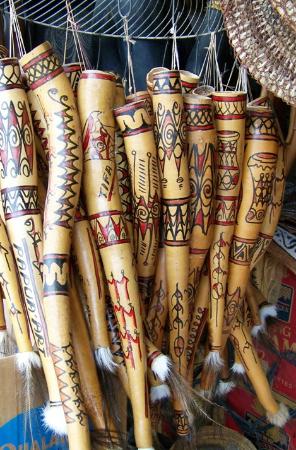
This cultural continuity also explains why DeMMAK has adopted the term “koteka” — the penis gourd worn by highland men as traditional clothing — as its organizing identity. As documented in multiple sources, the Indonesian government launched “Operasi Koteka” in 1971-1972, attempting to replace koteka with shorts and shirts as part of a modernization campaign. The effort failed disastrously — communities lacked changes of clothing, soap, or familiarity with garment care, resulting in skin disease and ridicule (Wikipedia — Koteka). By reclaiming “koteka” as a political and cultural identifier, DeMMAK transforms an object that was the target of state-imposed assimilation into a symbol of indigenous self-definition. The term now signifies not just a garment but an entire worldview — the right to modernize on one’s own terms, wearing one’s own identity.
4. Administrative Complexity and Institutional Capacity
The 2022 administrative restructuring that divided Papua into six provinces created a new operational reality for DeMMAK. What was previously a single provincial jurisdiction — the original Papua province — is now fragmented across at least three provinces relevant to DeMMAK’s territory:
| Province | Capital | DeMMAK-Relevant Regencies |
|---|---|---|
| Highland Papua (Papua Pegunungan) | Wamena | Jayawijaya, Tolikara, Yahukimo, Lanny Jaya, Yalimo, Nduga, Pegunungan Bintang |
| Central Papua (Papua Tengah) | Nabire | Paniai, Mimika (highland portion) |
| Papua (residual) | Jayapura | Border areas, some Nduga communities |
Operating across these jurisdictions requires DeMMAK to navigate three separate provincial governments, three sets of provincial regulations, three budgetary processes, and three distinct political configurations of Papuan vs. non-Papuan political representation. Each province has its own governor, provincial parliament (DPRD), and customary council structure — all of which DeMMAK must engage to advance its codification, institutionalization, and legal restitution agendas.
This administrative complexity has several implications for understanding DeMMAK’s organizational nature.
First, it refutes the characterization of DeMMAK as an informal or ad hoc movement. Coordinating advocacy across three provinces, multiple regencies, and dozens of distinct clan and tribal groupings requires sustained institutional capacity — secretariats, communication systems, legal expertise, financial management, and strategic planning. The organizational structure described on Wikipedia — “managed under coordination of a Secretary-General that is assisted by Coordinators based on activities carried out within the Assembly” — reflects exactly the kind of functional specialization needed for this scope of operations.
Second, it situates DeMMAK within a broader Melanesian institutional tradition. The confederation model — autonomous tribes voluntarily associating under a coordinating secretariat — is not borrowed from Western NGO practice. It reflects indigenous Melanesian governance patterns, particularly the “big man” consensus systems documented across Papua New Guinea and Indonesian Papua, in which influence flows through networks of reciprocal obligation rather than hierarchical authority. DeMMAK’s innovation is not inventing a new organizational form; it is adapting a traditional form to operate within a modern state system.
Third, it highlights the asymmetry between DeMMAK’s organizational ambition and its operational constraints. The same geographic isolation that preserves cultural continuity also makes cross-regency coordination logistically demanding. Communication between Wamena and Enarotali, or between Tolikara and the Mimika highlands, requires flights that may not run for weeks, roads that wash out seasonally, and telecommunications infrastructure that remains unreliable. Any organization maintaining cohesion across these barriers is demonstrating resilience that belies its “fringe” portrayal.
Fourth, the administrative fragmentation may ironically strengthen DeMMAK’s hand in certain respects. Three provincial governments mean three potential points of engagement for policy advocacy, three opportunities to secure legal recognition for customary institutions, and three administrative contexts in which DeMMAK’s codified customary law could be incorporated into local regulations (Peraturan Daerah). A successful precedent in one province — for example, formal recognition of clan business entities in Highland Papua — could create momentum for replication in Central Papua and beyond.
The risk, of course, is fragmentation of DeMMAK’s own constituency as provincial boundaries create new political identities and patronage networks that compete with tribal confederation loyalties. How DeMMAK navigates this tension — maintaining inter-tribal unity across newly created administrative divisions — will be a defining test of its institutional durability.
Integrated Assessment
Taken together, these four dimensions — scale, geography, cultural continuity, and administrative complexity — paint a portrait of an organization that is:
- Substantial in constituency and territory, not marginal
- Strategically positioned for legal engagement rather than armed confrontation
- Culturally grounded in living indigenous institutions, not importing external ideology
- Institutionally capable of navigating complex multi-jurisdictional governance
Each of these characteristics is verifiable through demographic data, geographic facts, organizational documentation, and administrative records. None of them supports the prevailing security narrative that reduces DeMMAK to an extremist or violent entity. The gap between evidence and characterization is not a matter of interpretation — it is a matter of the information environment surrounding West Papua, where restricted access, political sensitivities, and security framing conspire to obscure what organizations like DeMMAK actually are and do.
The geographic and demographic evidence, examined honestly, points to a different conclusion: DeMMAK is an indigenous confederation of considerable scale and organizational sophistication, pursuing a culturally grounded modernization agenda through legal and institutional channels. Engaging with it as such — rather than through the lens of security framing — is a prerequisite for any meaningful dialogue about the future of Papua’s highland communities.